One of the favorite parts of my working day is trying to explain complex designs and software design patterns in very simple, day-to-day life terms. It eases understanding and helps those concepts stay registered in our brains much longer.
I’ve spent years navigating distributed systems, and I've found that connecting software paradigms to real-life scenarios is the fastest way to demystify architecture. Here is a leadership look at the ultimate masterclass in system design—the human body—and how its embedded biology teaches us to build fault-tolerant, highly available software.
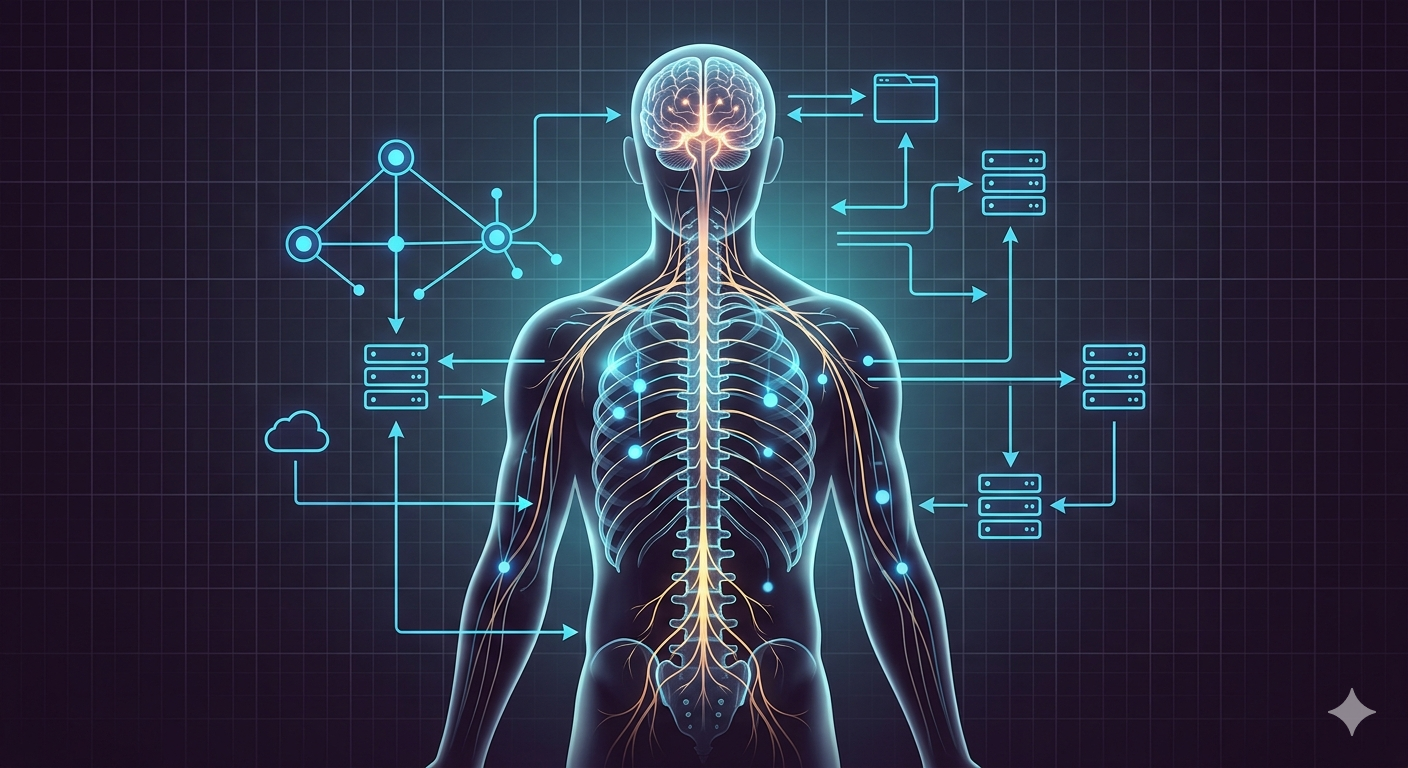
The Code in Our Anatomy
I don’t claim to know better, and all I attempt to do is keep things simple so it’s easy to digest for every other engineer, just like me when they encountered these ideas for the very first time. Because of this, I always ask everyone to refer to the official documentation and trust the code for the further minute details.
While using real-world analogies seems to work pretty well—especially when communicating across language boundaries—sadly, sometimes it doesn’t seem to work at all. This is particularly true when standing in front of “ditto copier machines”—engineers who blindly replicate the analogy or the snippet, potentially missing out on the actual crux of things.
This has been purely my personal observation, and you may have better attributions. But one of the most fascinating things in my design journey is our body. The human body, goes without saying, is one of the best-engineered systems ever built. It has a staggering number of classic engineering design patterns deeply embedded into its everyday runtime.
Why Nature is the Ultimate Systems Architect
Before mapping our code to our anatomy, we need to look at the sheer operational efficiency of human biology. Nature does not design with bloated dependencies or unmonitored infrastructure. Every loop is optimized; every pathway is bounded.
The efficiency of localized compute
If every low-level peripheral signal required deep, conscious cognitive processing, our central processor would suffer from immediate thread exhaustion. Nature solves this by localizing compute at the edge of the network.
Built-in degradation pathways
A system shouldn't just run perfectly or crash completely. When resources are constrained or trauma occurs, the human ecosystem prioritizes critical services (heart, lungs, brain) while gracefully shedding non-essential load.
Autonomic monitoring
Our internal telemetry infrastructure doesn't wait for a user-facing failure to fire an alert. It continuously monitors thresholds—heart rate, core temperature, blood chemical balance—adjusting parameters dynamically long before systemic failure occurs.
Pattern I — Multi-Layered Caching: The Subconscious Mind
“We are what we repeatedly do. Excellence, then, is not an act, but a habit.” — Aristotle
The first architectural marvel of our biology is how we manage compute overhead. If your system had to query the primary database for every repetitive read request, your architecture would collapse under the load.
In human terms, more than 90% of our day-to-day activities are performed entirely by our subconscious mind—governed by our muscle memories down to our spine. This is multi-layered caching operating seamlessly at every stage of the human stack. It ensures that when the upstream conscious brain is busy or constrained, the system establishes a high tolerance for continuous decisioning.

Muscle memory as the edge cache
When you type on a keyboard or walk down a street, you aren't calculating coordinates in your conscious brain. The routine has been hydrated into the local edge cache of your muscle memory. The request never hits the origin server.
The conscious brain as the heavy upstream
By serving 90% of daily transactions from the subconscious cache, the conscious brain preserves its finite CPU cycles. It remains free to handle complex, non-deterministic tasks—like debugging a distributed deadlock or writing code.
Handling cache misses gracefully
When you take a step and the ground suddenly slips beneath you, the edge cache encounters a "cache miss." Instantly, an interrupt signal is propagated upstream, evicting the current cached routine and forcing the conscious brain to take immediate, high-compute control of balance and recovery.
Biological Caching Matrix
| Layer | Biological Component | Software Equivalent | Architectural Benefit |
|---|---|---|---|
| L1 Edge Cache | Peripheral Muscle Memory | Local In-Memory Cache (Caffeine/Guava) | Sub-millisecond execution for repetitive physical routines without hitting the brain. |
| L2 Regional Cache | Spinal Cord Reflex Loops | Distributed Cache (Redis/Memcached) | Rapid, localized decisioning for sudden inputs (e.g., pulling your hand back from a hot surface). |
| Origin Compute | Conscious Cerebral Cortex | Core Database / Microservice Cluster | Heavy, resource-intensive processing reserved strictly for novel or strategic calculations. |
Pattern II — Fault Tolerance & Circuit Breakers: The Nervous System
“A tripped circuit breaker is not a failure of the system; it is a victory of design over catastrophe.” — Architectural Principle
Our nervous system consists of neurons, nerves, the spine, and our absolute favorite central orchestrator—the Brain. Neurons, with the help of nerves and the spine, report sensory signals back to the brain. They act as our communication channels, provided those signals are critical enough to reach the central orchestrator.
Among all the telemetry streaming through our neural network, the most critical signals are about pain.
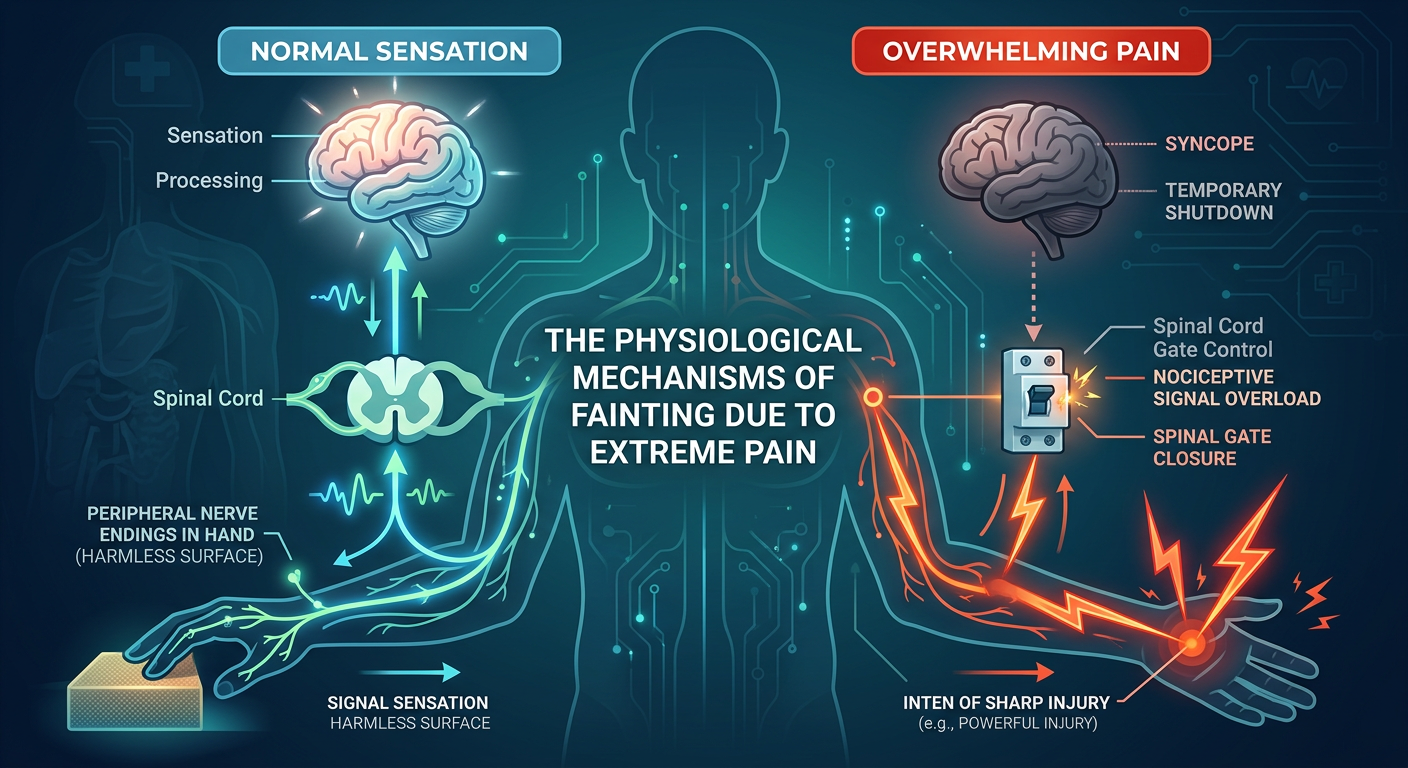
When we build distributed software, if a downstream dependency becomes slow or unstable, an unprotected upstream service will keep hammering it. This exhausts connection pools and triggers a cascading failure across the entire application. To prevent this, we deploy circuit breakers to cut traffic, protect the system, and allow the dependency to recover.
Sensory Input ───► Nerves/Spine ─── (Telemetry Signals) ───► Central Brain
Acute/Unbearable Pain ───► Spinal Cord ───X [Circuit Trips / Fainting] X───► Central Brain
Our brain operates on the exact same fault-tolerant architecture. When the body encounters acute, unbearable pain that poses a severe risk of permanent shock or systemic damage, the nervous system chooses to protect itself.
The circuit breaker trips. The system cuts off the conscious brain from the rest of the body for a short duration, causing the person to lose consciousness or faint. This isn't a failure of the body; it is a profound victory of design over catastrophe. By opening the circuit, the body gracefully degrades, shielding its most vital central processor from being overwhelmed by traumatic telemetry.
- Ensure every heavy telemetry stream (pain/error tracking) has an automated trip threshold.
- Isolate the central orchestrator (the brain) from cascading downstream failures.
- Design a clear fallback mode (unconsciousness/shock state) to lower core resource consumption during a crisis.
- Keep the communication paths (nerves) decoupled so localized trauma doesn't stop the entire network.
- Allow the circuit to remain open until the root-cause trauma metrics return to tolerable levels.
The Architectural Posture: Tuning Your Thresholds
Technical configurations are meaningless without proper tuning. A software circuit breaker with an arbitrary timeout threshold will either trip prematurely—causing unnecessary downtime—or trip too late, failing to prevent a crash.
We know the famous phrase, “Pain is inevitable, suffering is optional.” In the human ecosystem, the thresholds for this biological fault tolerance and circuit breaking are tuned completely differently for each one of us. An elite athlete or an individual who undergoes rigorous fitness regimes, intentional stress exposure, and disciplined training is actively tuning their infrastructure parameters.
By deliberately exposing their system to controlled adversity, they safely expand their error budgets. They train their neural network to handle higher volumes of stress, intense physical telemetry, and fatigue before the circuit breaker ever needs to trip.
What is the takeaway from this?
Whether you are designing a high-throughput payments engine or managing your own physiological and mental bandwidth, the architectural laws remain completely unchanged:
- Cache the predictable. Offload your high-frequency, repetitive tasks to muscle memory and subconscious habits. Protect your core cognitive CPU from origin-compute fatigue.
- Define your trip thresholds. Don’t force your central orchestrator to process infinite trauma. Identify your critical breaking points and build automated circuit breakers to protect the core.
- Embrace graceful degradation. Accept that systems will face overload. Design your architecture to intentionally drop non-vital processes so the primary engine stays alive.
- Tune through stress exposure. Use game days, chaos engineering, or rigorous physical training to actively tune your operational thresholds and expand your resilience.
- Look past the analogies. Don't be a ditto copier machine. Understand the foundational "why" behind the pattern, then refer to the code and the documentation to implement it with precision.
The goal isn't a system that never faces stress. That system doesn’t exist in engineering or in nature. The goal is an architecture so beautifully designed that even when it faces an overwhelming blow, it contains the blast radius, protects the core, and gives itself the space to recover and fight again.
If you lead engineering teams, design distributed systems at scale, or find yourself thinking about failure the way this piece does — I’d love to connect. The conversation is always more interesting than the metrics.
linkedin.com/in/pradeep · Pune, India